![]()
7 ¼" gauge
A high quality, ready-to-run engine suitable for the larger
garden railway or club track
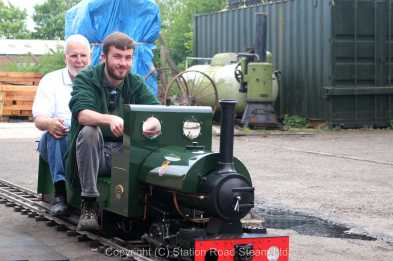
Designed and built in the workshop here, we conceived "Stafford" as a robustly-engineered, easy to drive locomotive - something equally at home on a garden railway or public running at the local club.
Having worked on some hundreds of locomotives over the years, a lot of the design choices fell into place easily:
An all-welded steel boiler with replaceable tubes - easy to
service and maintain, with the ability to run at 120psi making for easy
steaming and a good reserve of power
Full-sized controls - the regulator, reverser, steam and
water valves are built to fit a driver's hand, they aren't scale versions
which are difficult to get hold of and, when you do, are discovered to be
red hot!
Steel wheels. Cast iron wheels + steel rails = grooves in
the treads - in the first season on my Tinkerbell (admittedly running a
commercial service), which needed tyres at less than a year old. In contrast,
the wheels on our demonstrator engine still look pretty much the way they
left the lathe
Sealed ball-bearing axleboxes, which reduce maintenance,
increase service life (by keeping grit out of the bearings) and ensure that
as much power as possible gets to the drawbar, rather than ending up being
used to overcome rolling resistance.
Walschaert's gear for it's accurate control of the
valves over a wide range of cutoffs - this allowed us to set out the gear to
give generous full-gear cutoff for reliable starting (and I've lost count of
how many big engines I've driven that need a bit of driver's leg assistance
to move away after stopping on a "dead spot" in the valve gear)
whilst still allowing economic high speed running with the lever
"notched up"
Cast iron cylinders with bronze slide valves - the steam
passages are cored in which, whilst not the cheapest way of making patterns and castings, provide large, easy-flowing ports. Pistons are in iron,
fitted with the incomparable Clupet rings
TIG-welded stainless steel water tank. I can't
remember how many grotty old rust-filled tanks we've cleaned out and repaired on
other engines over the years (usually they either start leaking or shedding
rust into the injectors, both if you're unlucky) - Stafford's tank is welded, pressure tested then passivated to prevent corrosion at the welds before
priming with an acid-etch and spraying in two pack paint.
Ball valve regulator - as fitted to my Tinkerbell in 2002
and still going strong (not to mention just about every other successful
commercially-built locomotive of the last ten years). Silky smooth in
operation, light action even under high working pressures, absolutely steam
tight and easy to replace should the need ever arise

The engine has been designed from the outset in solid-modelled CAD, allowing us to test assemble and simulate the motion of all parts before transferring them to our CNC machines to cut metal. The valve gear was calculated from first principles before extensive simulation to check accuracy and symmetry of valve events at all cutoffs.
Frequently asked questions
Having talked to a lot of people during the development and testing of "Stafford" over the last twelve months, both at shows and in the workshop, some questions come up again and again:
Does the engine come with a boiler certificate?
Yes. We have a commercial boilermaker build our boilers in batches -
they are CE-marked and come complete with the maker's twice working pressure
hydraulic test certificate. Prior to despatch, our boiler inspector visits
to see the engine in steam and checks operation of the safety valve and
injectors. The engine is then issued with a new boiler certificate.
Subsequent testing can either be done by a commercial inspector - this
involves an internal inspection and steam test annually with hydraulic test
every 7-10 years - or your local model engineering club, who will steam test
each year, with a hydraulic test after the boiler is four years old, then
every two years thereafter.
I'm a complete beginner - would I be able to drive and
look after the engine?
Absolutely. The engine comes with a comprehensive set of operating &
maintenance instructions which cover everything from unpacking the engine
when it first arrives to dropping the fire at the end of a day's running.
Having taught people to drive everything from a 2 1/2 inch gauge
"Dyak" to a 7 1/4 inch gauge Baldwin K36 over the years, there
aren't many problems we haven't come across! Anything that isn't covered in
the manual, we're only ever an email or phone call away.
Is it possible to see an engine running?
Of course. Check to see if our demonstrator is here at the moment (it
normally is, although it sometimes goes out on loan to individuals or clubs)
- if it is, you're welcome to come and have a drive on our test track. In
addition, there are some clips of the engine running on our YouTube channel
here:
Club
running day at Evergreens Miniature Railway, September 2009
Running at Evergreens Miniature Railway, July 2009
Prototype
running on air in the workshop
Is the engine available as a kit?
No. I'm not a believer in kit-build for a variety of reasons. The
"stage a month, pay as you go" kit build market in the UK has had
a far from happy history over the last ten years - too often ill-conceived
and untested designs have ended up on sale which, in the end, has only led
to disappointed (not to say out of pocket) customers. Whilst it is desirable
from a manufacturer's point of view to have a regular payment every month
whilst an engine is being built (it pays the wages and buys material), the
advantage to the customer is far from obvious.
Having said all of that, there are well-run, reputable companies who produce
kit-build engines and have done so for years (and, if you look on the
archive of this website, you will see many examples that we have sold over
the years and been most impressed by) - we salute them, it's just not what
we want to do.
Will I be able to get spares in the future?
Yes. We keep most of the "service" type spares (bushes, valves,
etc) in stock on the shelf. The remainder can be manufactured rapidly using
the original fixtures and programs used to build the engine.
Is it guaranteed?
Yes. The engine is guaranteed for 12 months against defects in manufacture -
just like our secondhand engine policy, I like to think it's a "no
quibble" arrangement. The design is intended to provide a reliable,
easy to service piece of machinery which will give good service for many
years if looked after sensibly.
How do I order a "Stafford"
Ring us up and ask! We're currently on an 8-10 week delivery schedule,
although with the completion of the next batch of engines early in 2010, we
hope to get that down delivery ex-stock for the standard engine and 2-3
weeks for one needing optional equipment (including a non-standard colour).
There is a deposit of £250, for which you will be given a receipt, your
engine's works number and expected delivery date.
| Stock code |
Description |
Price |
| Prices below are quoted ex-works, exclusive of VAT which will be charged at the prevailing rate for engines shipped within the European Union | ||
|
LEN-1 |
7 1/4 inch gauge 0-4-0ST "Stafford", ready to run, in RAL6007 green two-pack paint finish |
£8500 |
| Options | ||
| Non-standard paint colour | £85 | |
| Vacuum brake equipment, comprising ejector, steam valve, vacuum gauge, driver's brake valve and all associated pipework | £225 |
|
Technical specification |
|
| Type | 0-4-0 saddle tank |
| Dimensions | |
| Length | 45 inches |
| Width | 19 inches |
| Height | 32 inches |
| Weight | 429 pounds dry |
| 500 pounds ready to run | |
| Cylinders | Cast iron |
| Bore | 2 1/4 inch |
| Stroke | 3 inches |
| Pistons | Cast iron, fitted two Clupet rings |
| Slide valve | Bronze |
| Lubrication | Mechanical lubricator |
| Drain cocks | Mechanical, rod-operated from footplate |
| Valve gear | Walschaert's, pole reverser on footplate |
| Boiler | Welded steel, expanded steel tubes, fitted fusible plug |
| Working pressure | 120 psi |
| Safety valve | Nabic 542 bronze pop-type, PTFE seat |
| Feed | Twin injectors |
| Maintenance | 3/8 BSP blowdown valve beneath firebox |
| 3/8 BSP washout plug in throatplate | |
| 2 x 3/4 BSP washout plugs in front tubeplate | |
| Wheels | Steel, 6 1/2 inch diameter, sealed ball-bearing axleboxes |
| Coupling | 10mm pin coupling on drag beam |
| Water tank | Stainless steel, TIG-welded, 4 gallon capacity |
| Finish | Two-pack paint |
| Chassis black | |
| Buffer beams red | |
| Tank, cab, cladding sheets RAL 6007 bottle green | |
| Brakes | Screw down mechanical brake acting on rear wheels |
| Options | |
| Vacuum train brake | Ejector, steam valve, vacuum gauge, driver's brake valve |
| Compressed air start valve | |
| Finish | Non-standard colour |

![]()
mike@stationroadsteam.com
Telephone +44 118 971 3739
Web site copyright © Station Road Steam Ltd 2001-2010